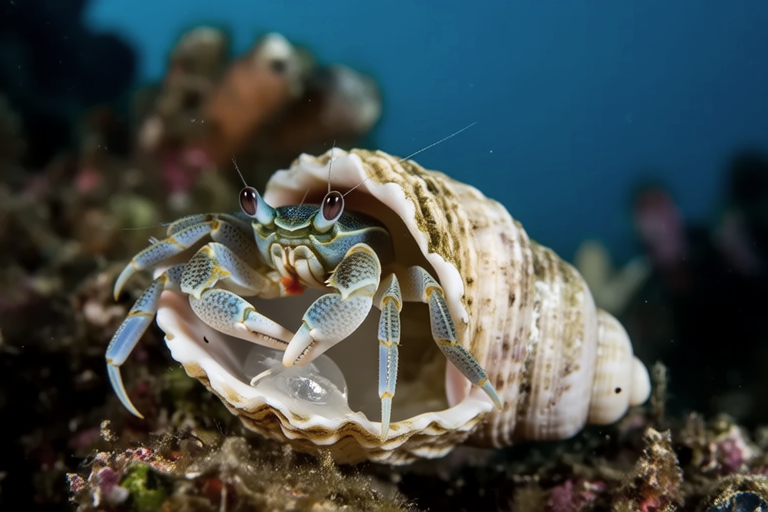
The Unique Lifecycle and Symbiotic Relationships of Pea Crabs
Pea crabs, small crustaceans that live within the bodies of other marine animals, have an intriguing lifecycle and complex symbiotic relationships. These tiny creatures, measuring less than an inch in length, can be found in various habitats throughout the world’s oceans, from shallow coastal waters to the deep abyssal plains. Their fascinating existence is marked by a delicate balance with their hosts, which includes mollusks such as mussels and oysters, as well as echinoderms like sea cucumbers. This article delves into the lifecycle, symbiosis, challenges, cultural significance, and ecological importance of pea crabs, offering insights into their vital role in marine ecosystems.
Lifecycle and Habitat
Pea crabs undergo a unique lifecycle, beginning as eggs that hatch into free-swimming larvae. These larvae then seek out suitable hosts, often sea cucumbers or bivalve mollusks, where they settle and develop into adults. The specific host species depends on the crab’s genus, with some preferring mussels and others favoring sea cucumbers. Once inside their hosts, pea crabs remain there for the rest of their lives, relying on the host’s body cavity for protection and nutrients. In the case of mussels, pea crabs reside within the mantle cavity, while sea cucumber-dwelling pea crabs inhabit the animal’s digestive tract or body cavity.
Pea crabs are found in diverse habitats, including coastal areas, estuaries, and deep-sea environments. They thrive in conditions where their hosts are abundant, which can vary widely depending on the species. Some pea crabs prefer rocky shores, where mussels attach themselves to the substrate, while others inhabit sandy or muddy seafloors where sea cucumbers burrow. Despite their small size, pea crabs play a crucial role in maintaining the health of their hosts and the broader marine ecosystem.
Symbiotic Relationships
The relationship between pea crabs and their hosts is a classic example of commensalism, where one organism benefits without significantly affecting the other. For pea crabs, this arrangement provides shelter, protection from predators, and access to food resources. In return, they offer no direct benefit to their hosts, although some studies suggest that their presence may contribute to the host’s overall health. For instance, pea crabs living within mussels may help regulate the flow of water through the host’s gills, improving respiration and potentially enhancing the mussel’s ability to filter-feed.
In the case of sea cucumbers, pea crabs may play a more active role in maintaining the host’s health. Sea cucumbers are known for their ability to expel their internal organs when threatened, a process called evisceration. After evisceration, the sea cucumber regenerates its lost tissues. Some researchers propose that pea crabs living within sea cucumbers may assist in this process by providing nutrients or helping to ward off potential pathogens. However, more research is needed to fully understand the extent of this interaction.
Adaptation Strategies and Challenges
To survive within their hosts, pea crabs have evolved remarkable adaptations. Their flattened bodies allow them to fit snugly within the confines of their hosts’ cavities, while their reduced limbs enable them to maneuver efficiently within these tight spaces. Additionally, pea crabs lack the claws and pincers typical of many other crab species, instead relying on their small size and agility to avoid detection by predators. Despite these adaptations, pea crabs face numerous challenges in their environment, including competition for limited space within their hosts and exposure to environmental stressors such as pollution and climate change.
One of the most significant threats to pea crabs and their hosts is overfishing. As fishing practices become more intensive and widespread, populations of both pea crabs and their hosts are declining. This decline can have cascading effects on marine ecosystems, disrupting the delicate balance of predator-prey interactions and nutrient cycling. To mitigate these impacts, it is essential to implement sustainable fishing practices and protect critical habitats, ensuring the long-term survival of pea crabs and their hosts.
Cultural Significance and Culinary Uses
Pea crabs have been valued for centuries in certain cultures, particularly in East Asia, where they are considered a delicacy. In China, Japan, and Korea, pea crabs are harvested from their hosts and consumed fresh or preserved. The crabs are typically steamed, boiled, or added to soups and stews, imparting a unique flavor and texture to the dish. In addition to their culinary uses, pea crabs hold symbolic meaning in some cultures, representing good fortune and prosperity. However, it is important to note that the consumption of pea crabs can have unintended consequences for marine ecosystems if not managed sustainably.
Ecological Importance
Despite their small size, pea crabs play a vital role in maintaining the health and stability of marine ecosystems. By regulating the flow of water through their hosts’ gills and contributing to nutrient cycling, pea crabs help ensure the survival of their hosts and the broader community of organisms that depend on them. Furthermore, pea crabs serve as an important food source for larger predators, including fish, birds, and mammals. Their presence within their hosts also helps to control the population of parasites and other harmful organisms, contributing to the overall health of the marine environment.
The decline of pea crabs and their hosts due to overfishing and other human activities could have far-reaching consequences for marine ecosystems. As populations of pea crabs and their hosts decline, the availability of food and habitat for other species may decrease, leading to imbalances in predator-prey dynamics and nutrient cycling. To prevent these negative outcomes, it is essential to adopt sustainable fishing practices and protect critical habitats, ensuring the long-term survival of pea crabs and their hosts.
Conclusion
Pea crabs are fascinating creatures with a unique lifecycle and complex symbiotic relationships. Their small size belies their importance in marine ecosystems, where they play a vital role in maintaining the health and stability of their hosts and the broader community of organisms that depend on them. While pea crabs face numerous challenges in their environment, including competition for limited space within their hosts and exposure to environmental stressors, their adaptability and resilience allow them to thrive in diverse habitats throughout the world’s oceans. By understanding the lifecycle, symbiosis, challenges, cultural significance, and ecological importance of pea crabs, we can better appreciate their value and work to protect them and their hosts for future generations.
